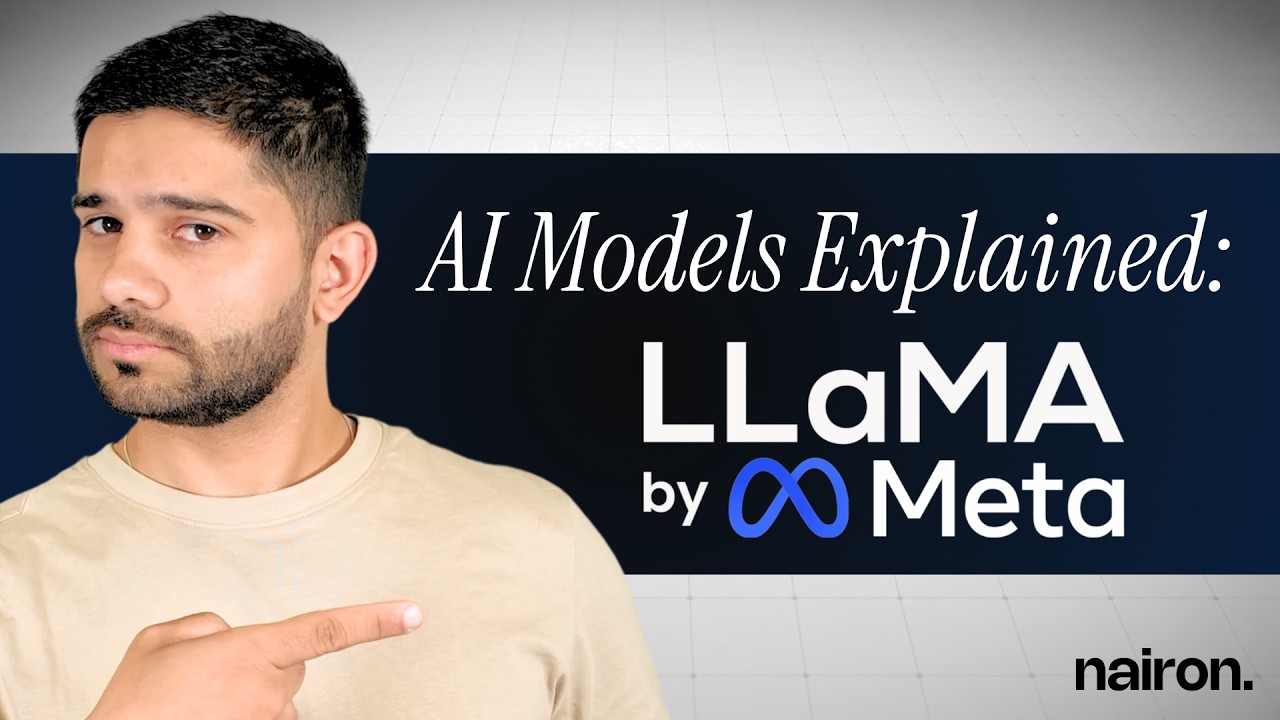
What is Meta Llama? Open weight models, free to self-host

Llama — watch on YouTube
6 min

In 30 seconds

  • Llama is open weight, so you download the model onto your own hardware and run it there with no API tokens billed.
  • Open weight is not open source: you get the weights and can run and tune them, but not the training data.
  • Llama trails the closed frontier models by roughly a year on quality, and wins on data safety and predictable cost.
  • Self-hosting fits the routine jobs like drafting emails and updating the crew calendar, while frontier work still goes to a paid API.

Llama is Meta’s family of open weight models. Claude, GPT and Gemini are closed source: you send a query, it goes to their cloud, an answer comes back. Llama gets downloaded onto your machine and runs there.

Open weight vs open source: what’s the difference?

Open weight means you get the model file. The weights, which are the trained numbers that make the model do what it does, sit on your hardware. You run the model yourself, you can tune those weights, and no API tokens get billed for any of it.

Open source would mean more. It would mean the training data as well, and a licence with no restrictions on what you do with any of it. Llama gives you neither. You get the finished model. You do not get the recipe. Meta’s bet gets described as a bet on open source, but the thing you can download is the weights.

What you give up against a closed model is capability. Llama models are significantly smaller than the closed frontier models, so they are less intelligent, slower and less capable. They do not compete on quality. They compete on safety and on cost.

Is Llama free?

Yes. Free to download, free to run, and free for commercial use since Llama 2. Nothing is billed per token.

The cost moves rather than disappears. Instead of paying a provider by the token, you pay for hardware: a machine with enough RAM to hold the model, or RAM rented from a cloud provider. Run a thousand requests this month or a million, and as long as the RAM copes, the invoice is the same.

How Llama got to version 4

Meta has been at this longer than the release history suggests. Its research department, FAIR, started in 2013. In 2025 Meta restructured around a new group called the Meta Superintelligence Lab, led by Alexandr Wang, the former CEO of Scale AI, one of the biggest data labellers. They have been quiet since, which is why there is so much anticipation about what comes next.

Public releases only began in 2023.

Model When What it is good for
Llama 1 2023 Researchers only. It leaked, so everyone else got it anyway.
Llama 2 Late 2023 The first official open weight release, free even for commercial use. Fine for a small local job, struggles with complex workflows.
Llama 3 2024 The biggest jump. Reasoning capability and light coding work, closing most of the gap to the frontier.
Llama 4 2025 Roughly a GPT-4 competitor. Still about a year behind the frontier, and free.

A few months from Llama 1 to Llama 2, then a year to Llama 3, then another year to Llama 4.

What hardware do you need to run Llama locally?

Not the laptop you already own. Llama 4 is cumbersome on a normal computer. You need a beefy machine with a lot of RAM, and that is what keeps local Llama out of daily use for most people.

The workaround is to rent RAM from a cloud provider like AWS and run the model on your own cloud infrastructure instead of on the machine under your desk. You still control the deployment and the data path. You just do not have to buy the hardware.

The trend runs your way. Each generation gets stronger while the RAM it needs drops. In a couple of years you could be running something with the capability of today’s Sonnet 4 or Sonnet 5 on your own machine.

That is Meta’s long bet, and it is how they intend to put the others out of business. You pay API prices only for frontier work. The agent that moves a job in your calendar or drafts your emails runs locally for nothing.

What Llama is good at

Self-hosting. You run the servers and the data processing yourself. In an organisation that means the racks in the back office. The data never leaves the network, which is what makes it usable in high-risk industries like finance and healthcare.

Cost predictability. You know what those servers cost you. A thousand requests or a million requests, the bill is the same as long as the RAM can handle the load. The job then is getting more work out of a fixed monthly cost.

Customising. Because the weights are open, you can change them to influence how the model responds. If you want more data-backed answers, you tune for that rather than front-loading a pile of instructions into every prompt.

Set against a closed frontier API, the trade looks like this.

Self-hosted Llama Closed frontier API
Quality About a year behind the frontier The frontier
Where your data goes Never leaves your network Their cloud
Cost shape Fixed monthly server cost, the same for a thousand requests or a million Billed per token
Setup and upkeep Cumbersome, and you maintain it Nothing to run

Should you self-host an AI model?

For a solar or HVAC operator the question is which jobs justify the hardware. Drafting customer follow-ups and updating the crew calendar are local-model jobs, and a Llama box in the back office does them at a cost you already know. Quoting and anything a customer judges you on goes to a frontier model, and you pay per token for it.

Most operators will land on that mix rather than picking a side. Apple is making the same bet from the other side: it has released no models of its own and is betting instead on selling the hardware that models run on. But setting up a local stack and maintaining it is cumbersome, and that alone sends plenty of people back to a cloud provider.

Meta is not the only source of open weights either. The Chinese labs release open weight models too, so there is real competition for the same position.

Full transcript

Expand

[music] Hey, my name is Mahan. I'm the CMO of Nairon. My name is Luka. I'm the CEO of Nairon. Welcome to our AI model series where we cover some of the most popular AI models out there in the market right now. And in today's video, we'll be doing Llama by Meta. So, Luka, you can take it from there.

All right. So, all the models that we've discussed so far, like Claude, GPT, or Gemini, are all closed source models. So you give them an input, you give them a query. Um they go off into the cloud and they come back to you with the final answer. So the difference is that Meta's Llama models run on your computer because they're open weight, which means essentially that the models are downloaded onto your computer. You can fine-tune exactly how much of the model you want to act a certain way. Sort of like fine-tuning, but not really. And then you can have it run on your computer, not costing you any API tokens or anything like that. But the models are significantly smaller and so they're not as intelligent, they're not as fast and they're not as capable as like the other closed source models. So they can't really compete on quality, but they can compete on safety and on cost.

So let's look at the company as an overall. In terms of Llama, obviously built by Meta, but similarly to Google, they've been actually working on ML and AI for the past couple of years. They had a department called fair um started all the way back to 2013 and only in 2025 did they actually restructure their internal organization around this new lab called the meta super intelligence lab and it's actually led by the ex CEO of scale AI one of the biggest data labelers um Alex Wong and so he came in he sort of restructured their organization and they've been kind of quiet since then and so there's a lot of anticipation what they're going to be doing in the next couple of years uh but it's really really cool.

Okay. And let's have a look at how Llamas progressed over the last couple of years. So even though they did have a decade of experience leading up to this AI race, they only really started releasing the models to the public in 2023 and they started off with the Llama 1 um which was only for researchers but it was sort of leaked and so others were able to use it. Fast forward just a couple of months later, they released Llama 2 and that's the official first openweight model um which was free for even commercial use as well. And so if you have a really small use case that you need run locally on your computer, it's actually a really good model to use u but it will struggle with a lot of the more complex workflows. Fast forward just a year after that, Llama 3 comes out and it's probably the biggest model that kind of closes the gap to the frontier. there's a lot of reasoning capabilities and sort of like low code type work can be done with uh Llama 3.

Just a year later, Llama 4 comes out and that's when we can actually start using Llama maybe as a GP34 competitor. I'm sort of still lagging one year behind the actual Frontier. Uh but it's free, right? And so you can essentially use it for a lot of the basic day-to-day tasks.

Um but it's still quite cumbersome on a on a regular computer. you need a very beefy computer with a lot of RAM uh to be able to run it locally. And so it's not really at that sort of daily uh usage that we can use it. But what you can do is you can rent RAM off of a cloud provider like AWS and you can run the model on your own cloud infrastructure rather than on your computer. But we can see how this essentially the model is getting stronger and the amount of RAM that it needs is getting lower. And so you could see in a couple of years where you could run a model like Sonnet 4 or Sonnet 5 today um on your actual local machine.

And that's kind of the bet that they're making long term. And that's kind of how they're going to put the others out of their business because you'll only need the you only need to pay for API usages for like the really smart, very frontier tech, but an AI agent that can change your calendar or write your emails for you. That can be all done locally.

I think we've touched on a couple of Llama's strengths uh just in the past couple of minutes, but let's go deeper into that. What does Llama actually shine at compared to the other models? For sure. So, number one is self-hosting. What does self-hosting mean? Self-hosting means that you run the operations, the servers, the data functioning, the data processing all on your local computer. In organizations, this means in your server stacks. So like if we go into the back offices, they have those racks with servers. Um, it runs there and so it's very safe. It never leaves the network. Um, super super safe especially in you know high-risisk industries like finance or in healthcare. Very good to use there.

Another one is cost predictability. So you know how much those servers cost you, whether you run a,000 requests or a million requests. If the server can handle it in terms of RAM, that's how much it's going to cost you. And it's just about utilizing the existing fixed cost that you have running monthly.

Another one is customizing. So because it's open weight, you can change the weights to influence how the model responds to you. So if you want more of a databacked solution, um more data backed answer, you can have the model give you that more fine-tuned and fine grained rather than having to like give a bunch of instructions ahead of time.

And what you mentioned earlier as well is that you know Meta right now is taking that bet on presuming that in the future the vast majority of AI models are going to be self-hosted and open source. So do you think that vision is going to come to pass?

It'll probably be a mix, right? So there's going to be a lot of use cases where you run the models locally. I mean Apple is making the same bet. If you look at Apple has not released any models, but its bet is that it can provide the hardware where the models can run. And so perhaps yes. Um but I do think that it's going to be quite cumbersome for people to set up and run and maintain. And so there could be cases where you decide to go with a cloud provider for those very reasons.

Uh but there's definitely a market for it. It's just a question of how much the market is going to lean towards open source and how much of the market's going to lean towards uh closed source. The Chinese models for example are actually open weighted as well and so there is a lot of competition. So we'll see we'll see how it goes.

We'll see how it goes which obviously in the future videos we'll also be covering some Chinese models and going deep into that. For the meantime guys you can subscribe to our newsletter links down in the description below. You can also find us on LinkedIn. We're very active on a daily basis. Until next time we'll see you in the next video.

Ready to put AI employees to work?
Book a call
256-bit SSL Secured
© 2026 Nairon, Inc. All rights reserved.
PrivacyTerms & ConditionsCookie PolicyAcceptable Use