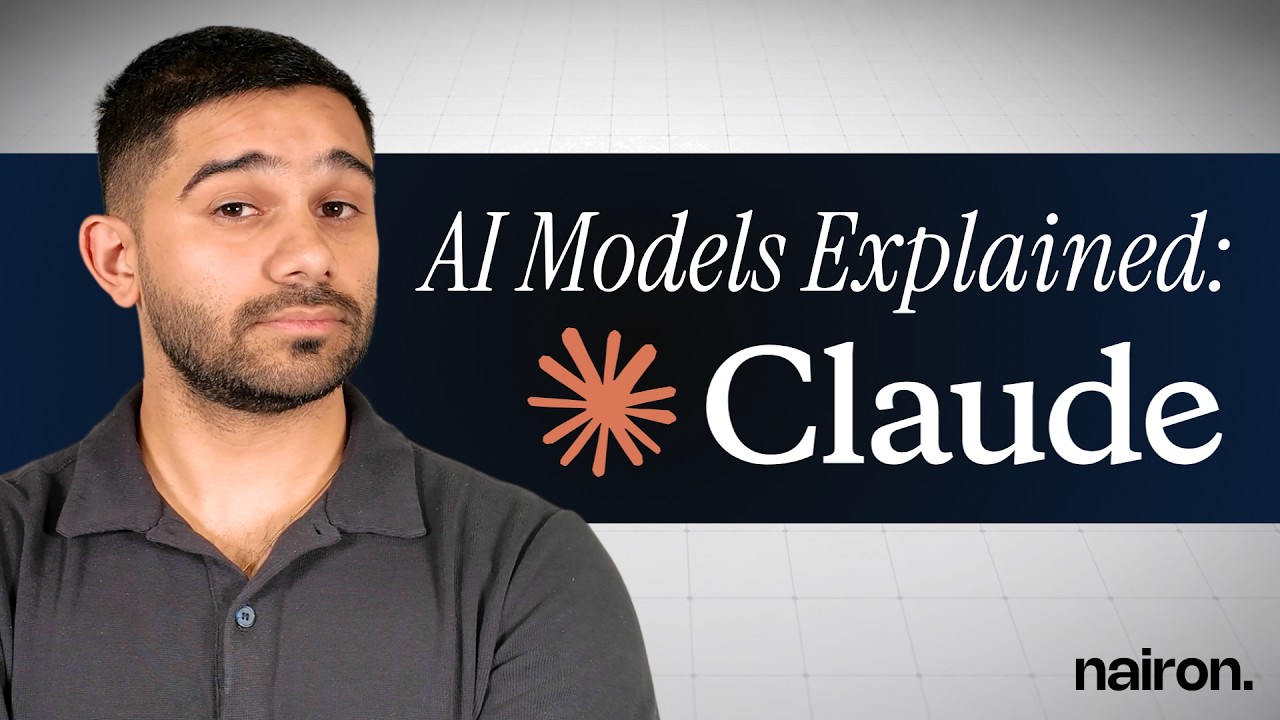
What is Claude AI? Anthropic's Haiku, Sonnet and Opus explained

Claude — watch on YouTube
6 min

In 30 seconds

  • Haiku is the fastest and cheapest tier, Sonnet is the everyday default, and Opus is for long multi-step runs and the hardest reasoning.
  • Claude is strongest at coding and long-running agent work, and shipping Claude Code gave Anthropic the data to keep widening that lead.
  • Anthropic writes its safety rules in at pre-training, so they are much harder to override than a system prompt added after training.
  • The frontier models are close enough on everyday questions that a year of familiarity with one usually beats switching to a slightly better one.

Claude is Anthropic’s family of AI models: Haiku, Sonnet and Opus. Haiku is the fastest and cheapest of the three, Sonnet is the one most people should be using, and Opus is for the hardest work. Claude is best at coding and long-running agent work, and after that at safety, which Anthropic builds in during pre-training rather than adding on afterwards.

Haiku, Sonnet or Opus: which one do you use

The three tiers have been in place since March 2024. They exist so you can trade speed and cost against depth.

Model Speed and cost What you run on it
Haiku Fastest, cheapest The same small job thousands of times: sorting inbound email, tagging jobs, one-line replies
Sonnet Middle on both The default for most work, including most day to day coding
Opus Slowest, most expensive Long multi-step runs, and reasoning you cannot afford to get wrong

Default to Sonnet. Move up to Opus when a task runs for hours or a wrong answer costs real money, and down to Haiku when volume matters more than depth. The video does not give prices, and what you pay turns on whether you are on a subscription or usage-based plan.

Who makes Claude, and who owns Anthropic

A group of OpenAI researchers left because they did not think the models were being built safely enough. They founded Anthropic, started building to rival OpenAI, and shipped the three models we use today. The company is registered as a public benefit corporation rather than the for-profit or non-profit structures OpenAI has run under. Its backers include Google, which owns Gemini, and Amazon.

What constitutional AI actually means

Anthropic writes an ethical constitution, a set of rules about what the model is and is not allowed to do, into pre-training. Pre-training is the stage where the model is still building its understanding of the world, so those rules sit underneath everything it later learns to say.

OpenAI does the equivalent job after training, in the system prompt. That difference has one practical consequence: a system prompt can be overridden. A constitution embedded at pre-training is much harder to talk the model out of.

Every Claude model, in order of release

When What shipped What it changed
Early 2023 Claude 1 Arrived about four months after ChatGPT
Late 2023 100,000-token context window Could digest some of the largest documents around at the time
March 2024 Haiku, Sonnet and Opus The three-tier line-up
Late 2024 Sonnet 3.5 The turning point for coding agents
Mid 2025 1,000,000-token context window Long-running tasks instead of small point solutions
Early 2026 Models up to 4.8 Multi-hour work, with the model checking and iterating on itself

Claude’s context window has been 1,000,000 tokens since mid 2025. That number is what turned coding agents from something that patched one function into something that works through a whole problem.

Fable 5 arrived about two weeks ago and was then taken off the market, so as of June 2026 everyone is waiting for it to come back. We have used it. It is an excellent coding model with strong applications for agentic work and agentic ops.

What Claude is best at

Coding, and the reason is partly historical. Claude was one of the first models behind a product aimed directly at software work. The coding tools before that were wrappers: Cursor and Windsurf, with Claude or Codex doing the actual work under the hood. Claude Code was Anthropic’s own coding product, the one you point at your codebase and use directly instead of through somebody else’s app, and running it gave them the data to train the next models on.

Two things make coding a good fit. Long-running tasks, which is what most real software work is, and reasoning. Those are the two capabilities Anthropic has pushed hardest on, and they are the pillars coding rests on.

The other reason people choose Claude is safety and reliability. If you work in finance or healthcare, Claude is the safer model to reach for. You may not be a bank, but a property manager holding tenant records and card details has a smaller version of the same problem. Some people also rate Claude highest for creative writing.

Claude vs ChatGPT: which should you use

Pick on the job, not the brand. Day-to-day drafting and summarising come back at much the same standard from every frontier model, so for that work the answer is whichever seat your team already has. Two things genuinely separate Claude, and neither shows up until you push past a single reply.

The first is software work that runs long. Anthropic put a developer product in front of engineers before its rivals did and trained the next generation on what came back through it, which is why Claude holds up over runs measured in hours. The second is where the guardrails sit. Anthropic embeds them before the model has finished learning, while OpenAI applies its equivalent afterwards at the instruction layer, which is the easier of the two to talk a model out of. That difference earns its keep in regulated work and almost nowhere else. Gemini barely enters the argument, and Google is one of Anthropic’s backers, so those two are not the clean rivals the branding suggests.

There is a less technical factor, and it decides more of these choices than benchmarks do. We started using Claude in 2024 because it was better than anything else available at the time, and we are still on it. Other models might be ahead this month. A year of knowing how a model responds to the way you write prompts is usually worth more than that.
Full transcript

Expand

[music] Hey, my name is Mahan and I'm the CEO of Nairon. My name is Luka and I'm the CEO of Nairon. In this video series we're going to be going over some of the most popular AI models out in the market right now. In this video we'll be going over Claude.

So, Luka, take it from there. Sure. So, one of my favorite models, essentially a group of OpenAI researchers ran away from OpenAI because they felt like they were not building these models as safe enough um and they went and started their own startup called Anthropic. Anthropic then started building their models to rival GPT 5.5 at the time um and they built the models that we know today, Opus, Sonnet, and Haiku. And so, what really sets them apart from ChatGPT, for example, that's backed by OpenAI, is that they built the corporation to be a public benefit corporation, not a for-profit or a non-profit how OpenAI was.

Um and they fundamentally have installed something called a constitutional AI, which essentially is at the pre-training level, which is the level that the model is still building on itself, they've implemented a constitution, sort of like an ethical constitution of what it's allowed to do or what what it's not or what it's not allowed to do. The difference is really that they're doing it at the pre-trained level. So, think about it this way, at the most core fundamental way that the LLM is able to understand the world, the constitution is embedded into it. Rather than OpenAI, where the GPT 5.5 is done in the post-training session.

With a system prompt. Exactly. So, technically it could be overridden. What's really cool is that they're actually backed by another model provider, the model provider of Gemini, Google, and Amazon as well. Um so, if we go into the timeline, in early 2023, the first sort of Claude 1 model came out, um just about 4 months after ChatGPT came out.

Um very quickly, in the late end of 2023, they actually had a model that was able to digest some of the largest documents. At that time, the context window was a 100k tokens. And then in the March of the following year in 2024, that's when we started seeing the three models that we know now, Haiku, Sonnet, and Opus. And then gave us that sort of three-tier system.

And it's really in late 2024 that Sonnet 3.5 comes out, and that is a real turning point in the new era of coding agents. And just over a year ago, that's when the context window is expanded to have a 1 million token context window.

That really gave us the ability to have very long-running tasks for the coding agents. They could now start solving larger problems rather than just like little small point solutions, for example. In 2026, in the beginning of the year, we started seeing very big improvements in the models going all the way up to 4.8 right now, where essentially the models can work for multiple hours solving very big problems, checking on its work, and iterating off of that. And so, right now, we're in June 2026. Fable 5 came out about 2 weeks ago. It got taken off the market. And that's where we're at.

We're at the crossroads waiting for Fable 5 to come out. It's essentially, and I've tried it, a amazing model for coding. And it has a lot of really good applications for agentic work and agentic ops. I think you just touched on something very important there, which is coding, which is something Claude is amazing at.

So, let's take a deep dive again. As mentioned before as well, most frontier models are very good at almost everything now to a point where the average person is not really going to be able to tell the difference. But where does Claude actually shine compared to every other model? I think Yeah. So, you said it right there.

Coding is really what Claude is best at, and mainly because it was one of the first models that shipped out a product that directly impacts coding. A lot of the coding tools that we used before were essentially huge wrappers, perhaps like cursor or windsurf, that used Claude behind the hood or used codex behind the hood to actually do a lot of the coding. Then Claude code came out, which was Claude's official coding product, which then you could use directly to code, which helped them gather all the data and gather all the the They helped them gather all the data that they needed to train and further improve the models. And so, when we're thinking about long-running tasks, which typically happens in coding, when we're looking at reasoning, which all three are the fundamental pillars of coding, makes coding one of the best applications for Claude. Now, it's also very important to know that if you're really interested in safety and reliability, perhaps you're in the financial or healthcare industry, then Claude is a much more safer model to use in this case. Especially if you're looking at writing, some people say that it's much better at creative writing.

I don't know, you might know better. I can attest that for sure. And and it goes back all the way to 2024 where I personally started using Claude. It was superior to anything else I had used at the time. For sure. And you might have stuck to it.

Yes. And other models right now perhaps are better, maybe. But because you've spent the last year on Claude, you're probably you know, still sticking on Claude. Again, Claude is just one of the most popular models that in the market right now.

Their rise to global dominance you could say has really taken off in the last 18 months or so. Prior to that, a lot of people didn't know about Claude. In future videos, we'll go through some of the other models that are having a big impact right now. Till then, guys, you can subscribe to our YouTube channel.

You can connect with us and get in touch directly through LinkedIn. Until next time, we'll see you in the next video.

Next in AI Models ExplainedGemini
Ready to put AI employees to work?
Book a call
256-bit SSL Secured
© 2026 Nairon, Inc. All rights reserved.
PrivacyTerms & ConditionsCookie PolicyAcceptable Use