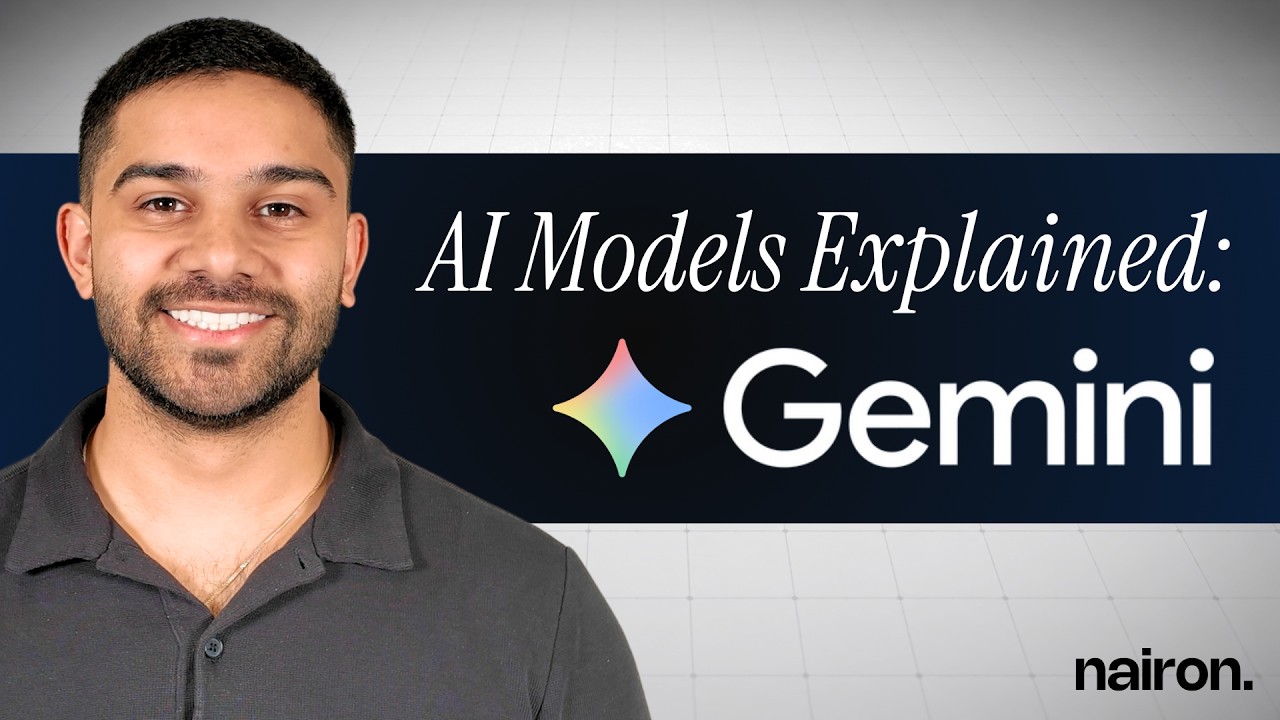
Gemini is Google’s model family. Three ship today, Pro, Flash and Flash Lite, and the current generation is Gemini 3, released at the end of 2025.
What Gemini has always done differently is take video, images and text as input rather than treating text as the main event.
Where Gemini came from: DeepMind, Brain and Gemini 3
Google bought DeepMind more than ten years ago, then spent about a decade building an internal product called Brain that never really landed. ChatGPT forced the issue in 2023. Google merged Brain with the DeepMind team, pointed them at a single line-up, and shipped Gemini.
| When | What shipped | What it changed |
|---|---|---|
| End of 2023 | Gemini 1 | First model multimodal from day one: video, image and text |
| A year later | Gemini 1.5 | Million-token context window while the market sat at 150,000 to 200,000 |
| 2024 and 2025 | Gemini 2 and 2.5 | Two releases, still behind Claude and ChatGPT |
| End of 2025 | Gemini 3 | First Gemini that rivals them |
The 1.5 jump is the one worth understanding. A context window is how much the model can hold in one session, so going from 200,000 tokens to a million meant four times longer chats and four times more information in front of the model at once. That is the point at which providers could start selling long jobs instead of long chats.
Gemini Pro vs Flash vs Flash Lite
Three models ship, in the same three-tier shape as Claude’s Opus, Sonnet and Haiku.
| Model | Claude equivalent | Use it for |
|---|---|---|
| Pro | Opus | not covered in the video |
| Flash | Sonnet | not covered in the video |
| Flash Lite | Haiku | not covered in the video |
The video maps the tiers by name and stops there. If you already run Claude, the tier you pay for there is the tier to start on here.
What Gemini is best at
Multimodal work, still. The Gemini models generate text, images and video, and a lot of the studio-quality imagery you have looked at this year came out of them. Nano Banana, Gemini’s image submodel, is the obvious example.
Long sessions are the other one. That million-token window is what makes agentic work practical: an agent that spends an hour going through a month of dispatch records still has the first job sheet it read sitting in front of it when it writes the summary.
Where Gemini already lives: Gmail, Calendar and Search
What separates Gemini from the rest is where it lives. Open Gmail and it is there. Open Google Calendar and it is there. Google pushed AI capabilities out across tools it already owned and reached more than half a billion users overnight, which is not a thing any other model provider can do.
Search is the harder move. Google’s entire business is search results, so putting an AI answer at the top of the page means cannibalising the thing that pays for everything. That was the open question in 2023: whether a company would compete with itself. It has. Google has kept improving search by putting AI into it, and you can see the result in who uses Gemini now. Plenty of people are on it who were not a couple of months ago.
Should you use Gemini?
If your company runs on Google Workspace, a Gemini model is already sitting in the tools your office manager opens every morning. Check that before you buy a separate seat somewhere else.
For a property management business, the multimodal side is what to test first. A photo of a vacant unit or a two-minute video walkthrough for a prospective tenant is valid input, so nobody has to type any of it up before the model can use it.
And if you tried Gemini in 2024 and wrote it off, that judgement is out of date. The version you rejected was two releases before the one that caught up.