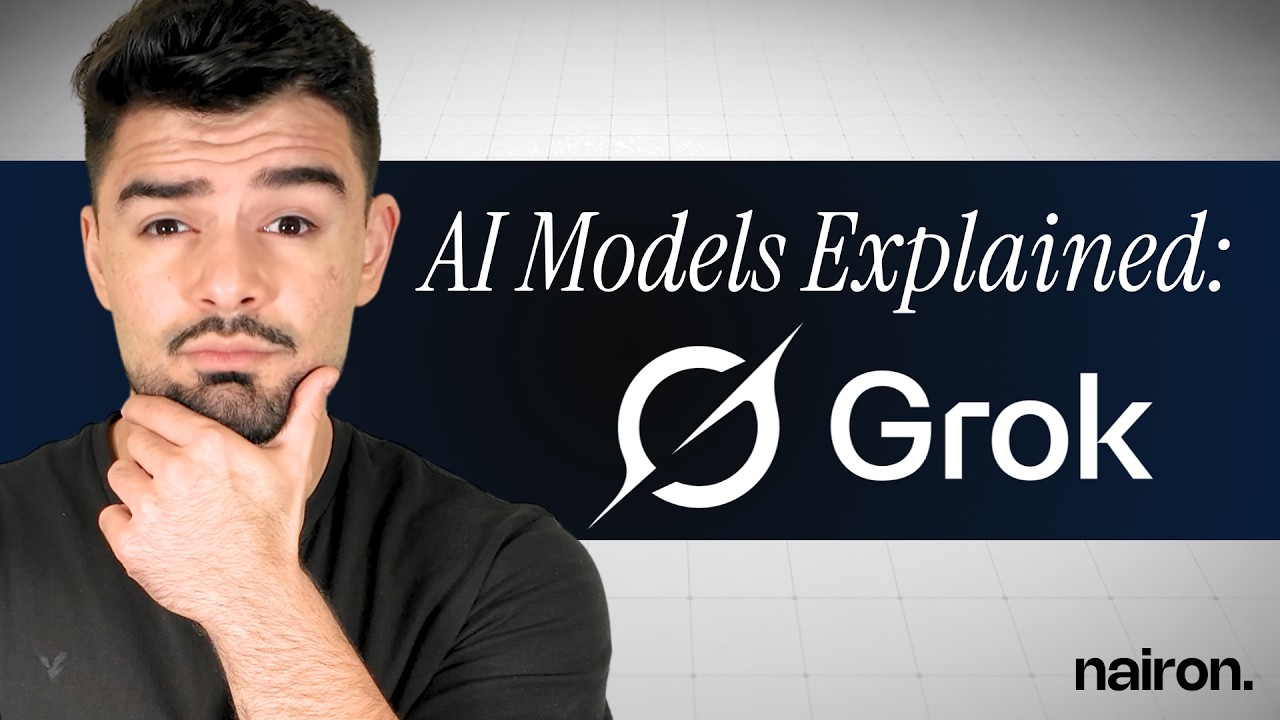
Grok is the AI model built by xAI, Elon Musk’s AI company, and it runs on X. That is its edge over ChatGPT, Claude and Gemini: real-time information, data that is minutes old. On most other measures it has been standing still for about a year.
Who owns Grok?
Elon Musk, through xAI. He co-founded OpenAI alongside Sam Altman and the rest of the team, left the board in 2018, and in early 2023 started xAI as a competitor. Grok came out of that. The stated mission is to build the most truth-seeking AI.
Three events, in order. xAI starts in 2023. Two years later it acquires X. A year after that, xAI and X together are acquired by SpaceX, which is also Musk’s. So Grok belongs to xAI, and xAI belongs to a rocket company.
Every Grok model, from Grok 1 to Grok 4 Heavy
The timeline is compressed next to everyone else’s. OpenAI has been shipping since 2018. Grok started at the end of 2023 and has produced about five generations in three years.
| When | Model | What it added |
|---|---|---|
| End of 2023 | Grok 1 | Launched to paying X subscribers as a pro feature, trained on X discussions and the news breaking there |
| About a year later | Grok 2 | Started competing with GPT-4o on reasoning and image generation |
| Not dated in the video | Grok 3 | Reasoning as the main pitch |
| Not dated in the video | Grok 4 | Passed Humanity’s Last Exam and other top benchmarks |
| July 2025 | Grok 4 Heavy | The last real jump. Flat since |
| Expected end of year | Grok 5 | Back in a race with Claude and GPT |
When is Grok 5 coming out?
By the end of the year, going on what the market expects rather than an announced date. Until it lands, the top of the line is still Grok 4 Heavy from July 2025, and nothing much has moved in the year since. Grok 5 is the release that decides whether xAI is racing Claude and GPT again or watching them.
What Grok is best at
- Real-time information. Grok has proprietary access to what is being posted on X, which puts it ahead of the other models on live data. Finance and trading products get built on top of it for that reason.
- Price. xAI prices aggressively. Grok is cheaper than the rest.
- Context window. Grok arrived with a 1 million token context window, which was a lead until the other models matched it. A 2 million token version exists, the largest context window you can use right now.
- Video input. Grok was among the earliest models able to take a video in. Models that generate video usually cannot read one: they chunk the file into frames and analyse the frames as images. Grok reads the video.
- Unfiltered output. Grok’s answers come back less filtered than the alternatives, so when you want an objective read on something rather than a careful one, Grok is the one to ask.
Grok vs ChatGPT, Claude and Gemini
| Grok | ChatGPT | Claude | Gemini | |
|---|---|---|---|---|
| Real-time data | Live X feed | Behind Grok | Behind Grok | Behind Grok |
| Price | Cheapest of the frontier models | Dearer | Dearer | Dearer |
| Context window | 1 million, 2 million available | Caught up to 1 million | Caught up to 1 million | Caught up to 1 million |
| Video input | Reads the video | Frames only | Frames only | Frames only |
| Filtering | Least filtered | More filtered | More filtered | More filtered |
The video treats the other three as one group on these axes, so the last three columns read the same by design. Four wins for Grok, and one loss underneath them all: general capability, flat since July 2025 while the others kept shipping. Grok is a specialist you reach for on a specific job. Moving the rest of your work onto it costs you more than the price saves.
Is Grok free?
Not on the evidence of how it shipped. Grok 1 went out as a pro feature to paying X subscribers, so the way in was an X subscription rather than a free tier. xAI prices below the other frontier models, which is one of the reasons people build on it. The video gives no plans and no per-token figures, so take it as cheaper, not as free.
Two routes in. The subscriber product inside X, which is the one an operator uses. And building directly on the model, which is what the finance and trading products do when they need data measured in minutes.
Where xAI is heading
xAI’s future is the infrastructure layer. It has signed deals with Anthropic to lease out its data centres, which means xAI hardware running Claude. Grok itself probably gets retired within a couple of generations: 5, 6, perhaps 7, and then that is the end of the line.
Musk’s ambition is to put data centres into orbit and run the inference up there, rather than in a desert where the chips have to be cooled. Among AI companies that is an unusual place to point a roadmap, and it tells you where the attention inside xAI is going.
Should you use Grok
For the everyday work in a property management business, writing renewal offers, summarising unit notes, handling after-hours enquiries, Grok gives you nothing the model you already pay for does not.
Reach for it when the job needs one of its specifics: live data measured in minutes, raw video handed to a model instead of screenshots pulled out of it, an objective answer instead of a careful one, or a price per call low enough to change what you can afford to run at volume. A maintenance technician pushing a walkthrough video of a flooded unit straight into a model, with no frame extraction step in between, is using the one capability Grok has that the others mostly do not.
Keep whatever you build on it portable. A model that has plateaued for a year, from a company whose owner is planning data centres in orbit, is not the thing to hard-wire into your dispatch process.